
Here is something I picked up recently.
It presents as a Bavarian Retourmarke / Retourbrief-Verschlussmarke ... essentially an official sealing label used by the postal administration when an undeliverable letter had to be opened in order to discover who had sent it.
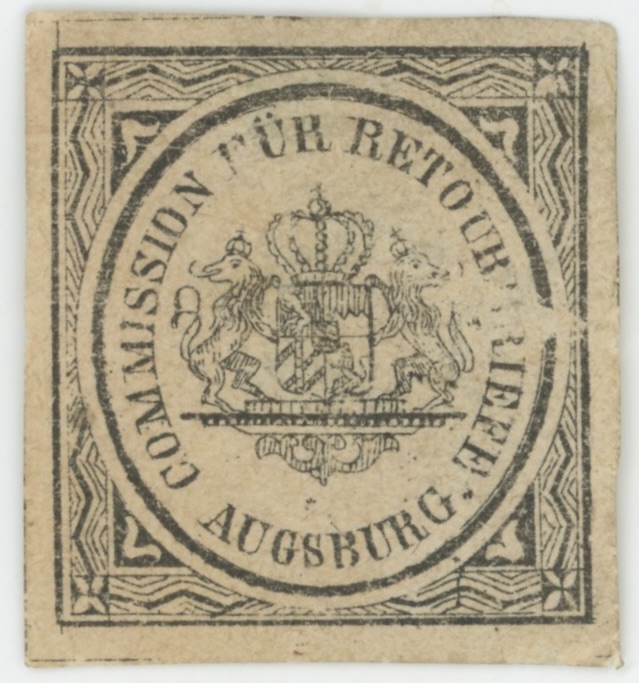
The inscription inside the oval reads:
[b]COMMISSION FÜR RETOUR-BRIEFE / AUGSBURG[/b]
with the Bavarian royal arms in the centre.
The back of the label has a fairly substantial thin, probably the result of an old hinge being removed. It is unused and there appears to be some residual gum.
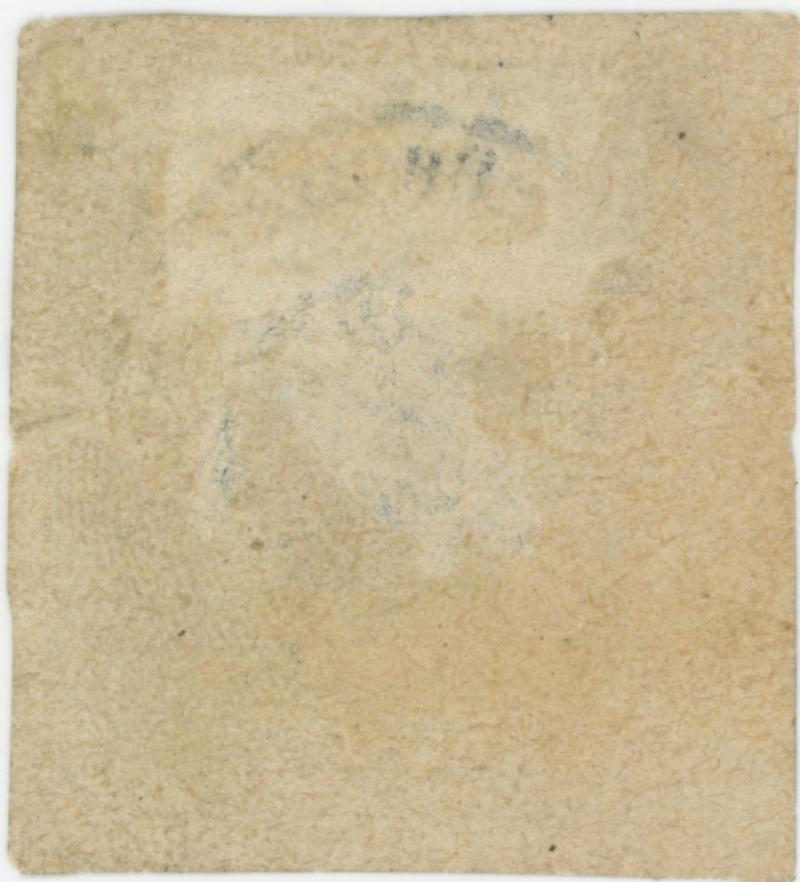
There is also a crease that has damaged or worn away part of the printed design on the front.
The genuine Augsburg type which this label imitates dates from roughly the 1860s and is apparently listed in Peter Sem's Bayern-Spezialkatalog as Sem 1.1. I understand that the Bavarian Retourmarken were once listed by Michel, but no longer.
The interesting part, of course, is what the genuine labels were used for.
Suppose a letter couldn't be delivered. Normally it would simply be returned to the sender. But what happened when there was no return address and nothing on the outside of the letter identified who had mailed it?
In that case the letter could be sent to a Retourbriefkommission ... a return-letter commission. Specially authorized postal officials were permitted to open the letter for the limited purpose of identifying the sender from its contents.
Once that had been done, the letter was closed again and one or more of these labels were pasted across the opening to show that it had been officially opened and resealed by the postal administration. The letter could then be returned to its sender.
In other words, this was a nineteenth-century Bavarian version of the procedure we would later associate with a Dead Letter Office.
Bertram W. H. Poole, in The Stamps of the German States, describes six Bavarian district chief offices in 1865: Augsburg, Bamberg, München, Nürnberg, Speyer and Würzburg. Corresponding arms-type Retourmarken were produced for them. Poole says they were lithographed in black on white paper in sheets of 84. He also notes that, except for Bamberg, there were two or three printings showing minor differences in the design. So some variation between genuine examples has to be expected.
Reprints, essays and forgeries of the early Bavarian Retourmarken are known. I bought this one partly because I thought it might be fun to check it out. Real or bogus?
I found an interesting 2023 discussion on the German Philaforum concerning another Augsburg label which looks very similar to mine. Several collectors eventually concluded that their example was probably a forgery.
That doesn't prove mine is, of course, but what interested me was their diagnostic process. They pointed to four things:
- the overall printing was much too coarse compared with a certified genuine example;
- the lettering, particularly COMMISSION, was crudely formed;
- the suspect label appeared to have been printed from an individual cliché rather than as part of the original lithographed sheet; and
- on the suspect example the inner and outer lines of the upper frame converge at the upper-right corner, whereas on a genuine Augsburg label on cover, certified by Brettl BPP, the two frame lines remain clearly separated.
Source: philaforum.com/forum/thread/41574-eine-besondere-verschlussmarke-retourmarke-aus-augsburg
So ... back to my seal.
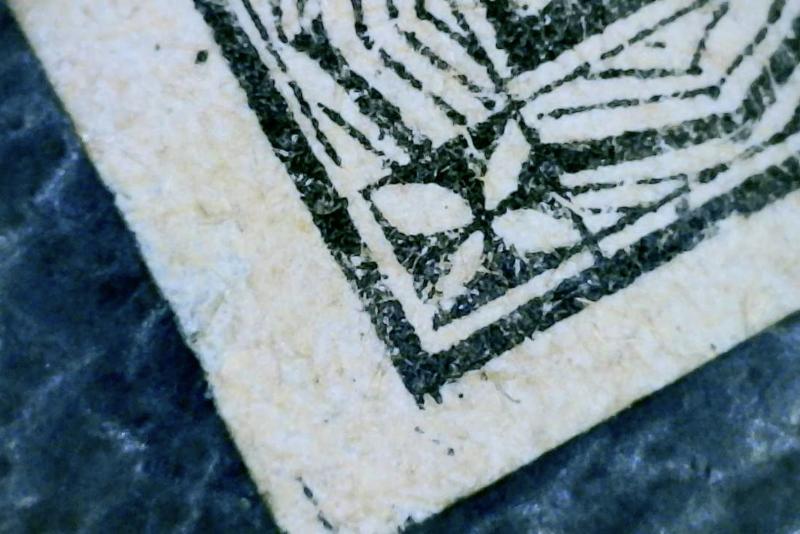
1 — The printing
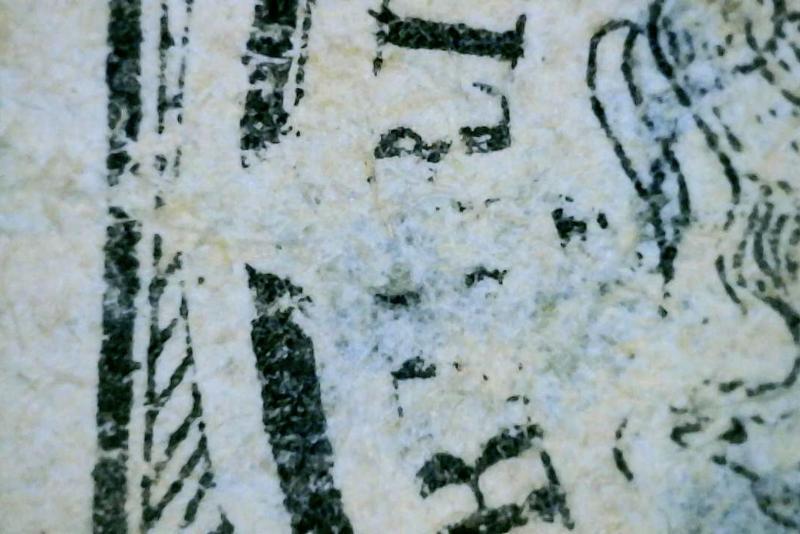
It certainly is coarse. Under the microscope, this is not simply an impression that is a little weak or blurred. Much of the detail breaks down into rather crude, irregular masses of ink.
2 — The lettering
This is perhaps even more suspicious. Have a close look at COMMISSION. The C is very crudely formed, and the two Is are noticeably different from one another.
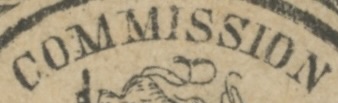
This looks to me less like an otherwise good design suffering from poor printing and more like the letters themselves were rather crudely reproduced.
Interestingly, Peter Sem is quoted in the German discussion as warning that forgeries of the early Bavarian Retourmarken are known, with a more primitive execution and poorer-quality paper. Apparently the demand was encouraged by spaces for these labels being included in printed albums. Completionist fever? (smile)
3 — Possible evidence of an individual cliché
There are faint straight horizontal lines outside the printed design, above and below the frame. I have marked them with arrows.
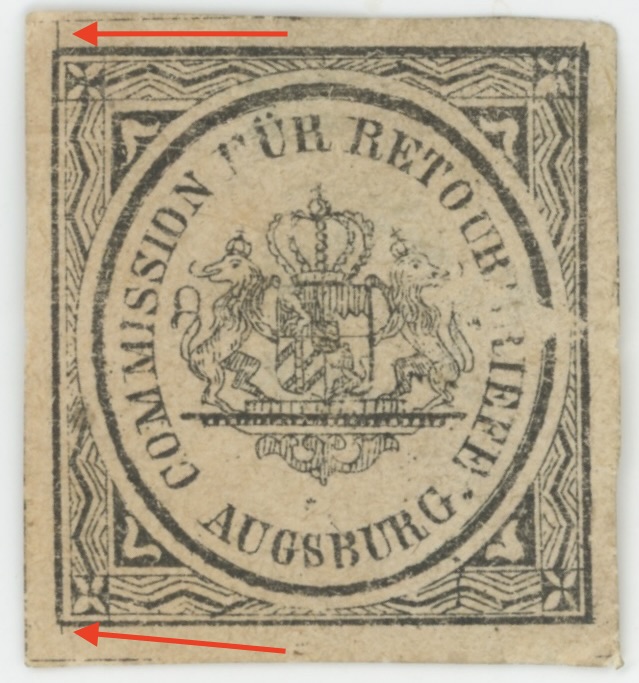
They appear to run parallel with the frame but continue beyond the edge of the design. This is similar to a feature noted on the suspect Augsburg example discussed on Philaforum, where collectors suggested that the forgery had been produced from an individual cliché, rather than as one subject within the original lithographed sheet of 84.
4 — The upper-right frame
This is much more persuasive.
On my example the inner and outer lines of the upper frame converge and effectively run together as they approach the upper-right corner.
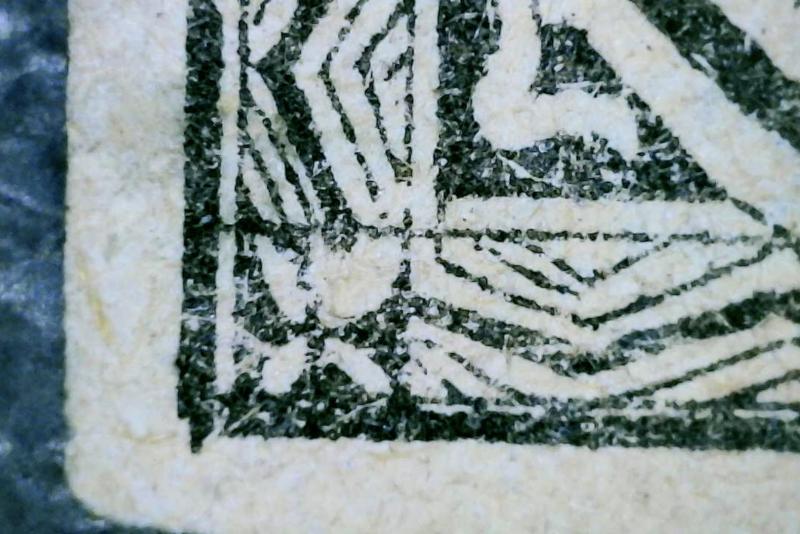
This is exactly the feature noticed on the suspect example in the German discussion.
Putting it all together, my conclusion is that this is almost certainly not an authentic Augsburg Retourmarke. I think it is most probably a forgery of Sem 1.1, quite possibly an old one.
Still, for a few dollars I think I got my money's worth. It was a lot of fun digging into this. (smile)
Cheers, Hugh
It presents as a Bavarian Retourmarke / Retourbrief-Verschlussmarke ... essentially an official sealing label used by the postal administration when an undeliverable letter had to be opened in order to discover who had sent it.
The inscription inside the oval reads:
[b]COMMISSION FÜR RETOUR-BRIEFE / AUGSBURG[/b]
with the Bavarian royal arms in the centre.
The back of the label has a fairly substantial thin, probably the result of an old hinge being removed. It is unused and there appears to be some residual gum.
There is also a crease that has damaged or worn away part of the printed design on the front.
The genuine Augsburg type which this label imitates dates from roughly the 1860s and is apparently listed in Peter Sem's Bayern-Spezialkatalog as Sem 1.1. I understand that the Bavarian Retourmarken were once listed by Michel, but no longer.
The interesting part, of course, is what the genuine labels were used for.
Suppose a letter couldn't be delivered. Normally it would simply be returned to the sender. But what happened when there was no return address and nothing on the outside of the letter identified who had mailed it?
In that case the letter could be sent to a Retourbriefkommission ... a return-letter commission. Specially authorized postal officials were permitted to open the letter for the limited purpose of identifying the sender from its contents.
Once that had been done, the letter was closed again and one or more of these labels were pasted across the opening to show that it had been officially opened and resealed by the postal administration. The letter could then be returned to its sender.
In other words, this was a nineteenth-century Bavarian version of the procedure we would later associate with a Dead Letter Office.
Bertram W. H. Poole, in The Stamps of the German States, describes six Bavarian district chief offices in 1865: Augsburg, Bamberg, München, Nürnberg, Speyer and Würzburg. Corresponding arms-type Retourmarken were produced for them. Poole says they were lithographed in black on white paper in sheets of 84. He also notes that, except for Bamberg, there were two or three printings showing minor differences in the design. So some variation between genuine examples has to be expected.
Reprints, essays and forgeries of the early Bavarian Retourmarken are known. I bought this one partly because I thought it might be fun to check it out. Real or bogus?
I found an interesting 2023 discussion on the German Philaforum concerning another Augsburg label which looks very similar to mine. Several collectors eventually concluded that their example was probably a forgery.
That doesn't prove mine is, of course, but what interested me was their diagnostic process. They pointed to four things:
- the overall printing was much too coarse compared with a certified genuine example;
- the lettering, particularly COMMISSION, was crudely formed;
- the suspect label appeared to have been printed from an individual cliché rather than as part of the original lithographed sheet; and
- on the suspect example the inner and outer lines of the upper frame converge at the upper-right corner, whereas on a genuine Augsburg label on cover, certified by Brettl BPP, the two frame lines remain clearly separated.
Source: philaforum.com/forum/thread/41574-eine-besondere-verschlussmarke-retourmarke-aus-augsburg
So ... back to my seal.
1 — The printing
It certainly is coarse. Under the microscope, this is not simply an impression that is a little weak or blurred. Much of the detail breaks down into rather crude, irregular masses of ink.
2 — The lettering
This is perhaps even more suspicious. Have a close look at COMMISSION. The C is very crudely formed, and the two Is are noticeably different from one another.
This looks to me less like an otherwise good design suffering from poor printing and more like the letters themselves were rather crudely reproduced.
Interestingly, Peter Sem is quoted in the German discussion as warning that forgeries of the early Bavarian Retourmarken are known, with a more primitive execution and poorer-quality paper. Apparently the demand was encouraged by spaces for these labels being included in printed albums. Completionist fever? (smile)
3 — Possible evidence of an individual cliché
There are faint straight horizontal lines outside the printed design, above and below the frame. I have marked them with arrows.
They appear to run parallel with the frame but continue beyond the edge of the design. This is similar to a feature noted on the suspect Augsburg example discussed on Philaforum, where collectors suggested that the forgery had been produced from an individual cliché, rather than as one subject within the original lithographed sheet of 84.
4 — The upper-right frame
This is much more persuasive.
On my example the inner and outer lines of the upper frame converge and effectively run together as they approach the upper-right corner.
This is exactly the feature noticed on the suspect example in the German discussion.
Putting it all together, my conclusion is that this is almost certainly not an authentic Augsburg Retourmarke. I think it is most probably a forgery of Sem 1.1, quite possibly an old one.
Still, for a few dollars I think I got my money's worth. It was a lot of fun digging into this. (smile)
Cheers, Hugh
Hugh MacDonald, Wolfe Island
Member: BNAPS. PHSC, MPHS, FPHS, CSS
Auxiliary Markings Club, Postal Stationery Society, British Postmark Society,
Civil Censorship Study Group
ArGe Deutsche Feldpost: 1914-1918 e.V.
Member: BNAPS. PHSC, MPHS, FPHS, CSS
Auxiliary Markings Club, Postal Stationery Society, British Postmark Society,
Civil Censorship Study Group
ArGe Deutsche Feldpost: 1914-1918 e.V.